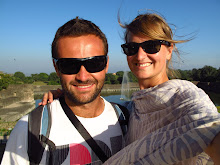
Hi All,
Sorry I have not written in some time, again, we have been very busy every day, with barely a minute between activities to spare. As such, I have written this over the past 7 days or so, in stages.
We have traded the mountains for the desert: traded fresh, crisp air for dry, hot gusts; rainforest for sparse shrubs hunching in the wind; huts nestled into the mountainside for boxy sandstone houses jutting from the baking earth; unassuming, plain-clothed men for deep-set faces, luminous turbans, tweaked moustaches and glittering adornments.
We have moved into Rajasthan. From what I can gather, Rajasthan is a place of immense pride and history. For much of its past, Rajasthan has been divided into smaller kingdoms with all the palace intrigue (alliances, marriages, enormous wealth and great battles) one associates with these kingdoms. Such was the Rajput’s autonomy and independence, that it took great cajoling for the Rajputs to even join the Indian federation at partition in 1947. I was interested to learn that the current dispute in Kashmir goes back to an indecisive Hindu king ruling over a Moslem majority that ummed and arrrhed about whether to become a part of India or Pakistan. A Pakistani invasion forced his hand, but the uncertainty remains.
More of Rajasthan later. After our last post we re-circumnavigated the lake in our giant swan. After we had been to a pastry shop, i had my first, very brief, bout of nausea. It came on very quickly, but the paddle around the lake fixed it. As you would expect, many of the bodies of water in India are horrendously polluted. The main river that runs through Delhi, the Jumna (pronounced Yum-na) has been variously described as ‘black ooze’ and ‘filth’. Industrial waste, sewerage and the aftermath of festivals have all poisoned the river, possible beyond repair according to the media reports here. Surprisingly, water quality has been rapidly declining over the past five years. There was an article in the paper recently detailing the level of some bacteria in the waterways. Even the normally clean Himalayan parts of the river are becoming polluted. A long digression but you might expect that Nanital lake, a small, standing body of water would have suffered a similar fate. Not so. There is the standard rubbish here and there, (not as much as in the rest of India), but the government has come up with this clever way of aerating the water. They have actually dug under the lake and bored a series of airholes at the bottom to pump oxygen through. As such, the water is relatively clean and fish are abundant.
Another thing about littering. Many (certainly not all, I don’t want to pigeon-hole) Indian people just throw their rubbish whenever they happen to not need it anymore. We were on the toy train to Shimla, moving past pristine hills and the most uninterrupted greenage we had yet seen, and these two guys would just finish their lunch, and piece by piece throw their rubbish out the train window. It happens alot. It problematic enough for it to top a list of 10 bad habits people in Delhi have to fix before the 2010 commonwealth games.
We walked back to the hotel and the extravagant construction out the front of our room was almost complete. All the surrounding tress were draped with fairy lights of blue, yellow and red, in one corner of the property two gyus were standing with a hookah (I don’t know what was in it, probably scented tobacco). Roughly in the middle there was a huge, carpeted entertaining areas with dozens of tables, room for a band, all floodlit. We think the whole arrangement would have cost in excess of $100,000. It was for a wedding.
I managed to negotiate a taxi driver down from horrendously expensive to ridiculously expensive for the drive back to Kathgodam. We ate our final dinner and packed.
Most of the next day was spent on the train back to Delhi, when we called. We sat opposite a professor of management and his wife and were entertained by some very energetic kids climbing all over the sleeper carriages, throwing rubbish everywhere, and practicing their English on us. One girl was fond of throwing her (almost) empty packet of chips down near (sometimes on!) us and pleading ‘sorry! Sorry!, oh I am so very very sorry’.
We arrived back in Delhi. The guy at the prepaid rickshaw stand said that I could not buy a ticket to Karol Bagh, but somehow, five seconds later that was possible for Kate. It could have been Kate, or it could have been the policeman standing beside her. Either way, we got in a rickshaw through the choking clog of old Delhi. The driver didn’t really know where the suburb we were staying in was, so I figured he wouldn’t have much chance of knowing where the hotel was. He dropped us at the metro station at Karol Bagh. Karol Bagh is a big place and there are no street names or numbers and we walked around looking confused, accepting every piece of advice we could (while also being a sitting duck for the men selling 2m laminated maps of India and head-massage instruments) getting sent back and forth until someone from intrepid travel realised we must be looking for one of our hotels and guided us there.
The hotel was nice and clean. We met our group for this second part of the trip. In all we are 13 people (including the group leader): 2 Australian ladies in their 50s or so, 2 Australian guys from Melbourne, about 19, a couple from England/Australia, 2 British girls around 20, one Russian lady, and one solo-travelling Australian. Our group leader is a 29 year old guy from Rajasthan (all group leaders seem to be from the warrior caste in Rajasthan).
That evening we went out to dinner with Sam and Kristine (the lady we met on our first tour). Kristine is off to Darjeeling, but we will probably see her again in Goa. Sam is the property manager for intrepid. We had a great night over dinner, a beer and some coffee afterwards. I had the mix vegetable and a sumptuous, buttery garlic naan. I ate meat again too, as Sam ordered mutton and shared it around.
The next morning we headed out for the old Delhi walk of the Mosque, the spice markets and the Sikh temples. The weather was much cooler and overcast. Even though we had already done the walk, Kate and I enjoyed re-doing it, now being a little more comfortable in the onslaught. We returned to the mosque and re-ascended the spire. This time I was able to fully appreciate how enormous and magnificent is the red fort, and for the first time get a feel for what a more ancient Delhi would have looked like. I noticed that the mosque was connected to a market which was itself connected to the red fort, all built in, now smoothed, deep red sandstone. I was amazed to find out that Delhi had been continuously inhabited since possibly 3000BC. Many places rise and fall, but Delhi has been central to history on the subcontinent for many thousands of years.
On the walk through the spice market, we passed through a section for festival shopping with bright flowers dangling overhead. We stopped for a parantha at a tiny restaurant that Jehan Nehru ate. We stopped also for a ‘lassi’ - a cold, yoghurt-based drink which is the closest thing here to a good banana smoothie. We bought some almonds and pistachios for the 19 hour train journey ahead that afternoon.
The train was not as bad as I was expecting. The sleeper trains and generally comfortable, clean and air conditioned. We spent the afternoon and evening all chatting and getting to know one another and we slept reasonably well. In the morning the conversations continued and we arrived in Jaislamer surprised that nearly a full day earlier we had stepped onto he train in Delhi.
We arrived in Jaislamer at around 12pm. Apparently it was 42-45 degrees when we arrived, but I am struggling to tell the difference between 38 degrees and 45 degrees. It’s all just damn hot. Jaislamer is a different kind of hot though. Warm winds blow across the desert and the air is drier. In Delhi it is both hot and sticky. The heat in Jaislamer is more draining thasn you think too – a short walk through the streets leaves your mouth sticky and your head dizzy.
Jaislamier is used to be an important town on the Silk Road. It’s near the India-Pakistan border in central-west Rajasthan. The centrepiece of the town is a 12th century sandstone fort that still houses 5000 people. It is like stepping back in time, the streets are narrow, gold sandstone that has worn smooth over nearly a thousand years. Most of the buildings are as old, and retain all the delicate carvings of the time. In its prime, people in Jaislamier used to be extremely rich from looting and trading with caravans on the silk route. Wealthy merchants built these houses called ‘Havelis’ (mansions) that still stand today. The bigger, more grand and more beautiful your Haveli, the wealther you were. Much of the wealth and decadence is still apparent in the buildings, but the locals have taken to looting tourists instead of caravans these days.
Jaislmer reminds me a lot of Venice, minus the water and in the middle of the desert. Every corner is another postcard-photo. The fort at Jaslaimer is actually sinking into the sand (maybe that’s why it reminds me of Venice too). Because of poor drainage under the fort (which they are trying to fix), the fort will eventually disappear.
After arriving in Jaislamer, we drove to our hotel. We are staying inside the fort and the rooftop has views over all of Jaislamer town, the enormous wind farms and Indian army bases that surround the town, and the desert beyond. Soon after arriving, we took an orientation walk around the fort and into the town below.
I had enormous expectations about Jaslamier - being out in the desert, staying in a 12th century fort, watching a sunset (all a little touristy i know) were parts of our journey i had been most looking forwards to. I can truly say that it lives up to all expectations. As with all of india, there are sad and disturbing parts, and for the first time, some very touristy parts (there are a lot of westerners here, more than we have seen all trip), but the beauty of the place is immense.
Most of the fort has been preserved – you walk along the golden-cobbled streets and buildings, past stately white, Brahmin cows luxuriating in the shade, to be confronted at every corner with a building, rampart, or a temple hundreds of years old and decorated with the most precise and intricate carvings. At the same time there are children collecting rubbish and begging for money, shopkeepers yelling ‘come and spend your money here’, ‘come and see many beautiful and wonderful things’, women dressed in sequined red, hooded saris selling anklets, and open sewers that waft from time to time. One guy even just said ‘come into my shop and let me rip you off’. Business must be good. Then you will turn an innocuous looking corner that opens out to a view across the desert.
That afternoon, when it was cooler, we took an orientation walk through the streets, past a Jain temple, to a cannon aiming out over the plains, past the market outside the fort and to the ATM. Most of the shopkeepers knew we were on such a walk and would shout ‘when you finish tour, you come to my shop, bring your friends’. From what I can glean, Jaislamer survives mostly on tourism, and a little from the many army bases and wind farms.
We returned to the rooftop restaurant in time to watch the sunset, but the dust and haze over the horizon had blotted it out. We sat on some cushions at a low table and had a drink, ate dinner and listened to the group leader tell us the Sri-Lanka abduction story (although in far more detail). At festival time, they can take 5 days to tell the story. An interesting addition to this version was the presence of ‘deamon faced Lankans’ that are still inhabiting Sri-Lanka today. Again with the racism. We also talked alot among one another and listened to one of an English girl’s (Natasha’s) hilariously animated imitations of her Greek father. She in turn was inconsolable at many of another lady’s (Leanne’s) Australianisms.
The next morning we visited some of the Haveli’s around town. In total we visited two. The biggest one stood probably 3 stories tall with its entire facades covered in carvings of peacocks, elephants and various other patterning down to the detail of a fingernail. It was nice, but the whole town is so captivating that I was getting a little over-captivated, where something that is rightly stunning gets a ‘yep that was okay’.
In the afternoon we had free time, so Kate and I stimulated the local economy. We not doubt were horrendously ripped off (and there are certain people who have no qualms about telling you) but bought a couple of shirts, Kate bought a nice skirt (for $3 or so) and a leather water-holder (for the camel trek thing). I am fairly confident about conducting the full bargaining process in Hindi, but it a battle to get them to even speak Hindi, so touristy is the place.
The leader had organised for the entire group to be dressed in Rajasthan garb, to go and watch the sun fall over the fort from outside the town. So I was dressed in ‘pyjama’ pants and a loose shirt with a rainbow turban on, while Kate was decked out a full green and maroon full Sari. Kate looked exquisite, I looked like an imposter. I now think all of this was organised for the leader’s amusement, as we walked outside the fort past the chuckling and jeering of the locals. Others enjoyed it, and, yes now I am not doing it, I can see how it was funny, but it was among the most humiliating, cheesy, embarrassing, twee 30 minutes I can remember.
Anyway, we watched the sun cast its last over the fort and took a taxi to the restaurant we were eating at. Again, it was a magnificent place, a blocky, sandstone structure a few kilometres from the fort, but set right in the desert with views back of the fort rising over the town. I did my best to take some photos, and we’ll see how they are when they go up. We chatted and shared a drink and ordered our meal. Then, from below the balcony we were sitting from came the undulations of a drum, then another, then some cymbals and some other instrument.
I hate dancing.
At first it was okay, an Indian lady performed a traditional dance with all the hand waving and graceful movements. One of the ladies in the group who is prone to prefomrmative outbursts ascended the stage and started dancing and playing instruments. That is fine, I was happy to leave it to the professionals and the un-inhibited. Then more people got up, and eventually the Indian lady descended and I was up there with Kate gyrating and fumbling, turning out of time and waving my hands like the queen on amphetamines. All in my stupid rainbow turban and pyjama pants.
Afterwards everyone said, Kate you were so good up there...
Unfortunately Kate’s night went a little downhill from her graceful outfits and dancing. As we were about to eat dinner, Kate had to hastily find a bathroom and re-vistited some of the day. She is fine this morning (the next morning) but we went straight home in a rickshaw, she had some water and slept for 12 hous or so. I think it may have been a little heat-stroke.
Consequently, we have took it easy the next day. We met up with our old group leader, Shakti, for lunch and just chatted and drank tea sitting on the rooftop in the breeze. We then slowly packed for the camel trek, which was die to leave at 3pm.
We took jeeps about 45km or so out of Jasliameir, to a point where the camels were waiting for us. In all there were 12 camels (one for each of us) groaning, urinitating, farting and defecating to greet our arrival. Kate ended up on the biggest camel – a golden yellow, quite majestic camel – while ended up on the smallest and youngest camel who could be yet let off its owners leash (it must still have harboured dreams of freedom). We then rode out across the plains for 2 hours or so.
The landscape started with dark, hard, rocky land with leathery green shrubs that opened like hands from the earth. In time we passed goat herders and agricultural fields that had not seen rain in years. (the monsoon has been very bad in rajasthan, but here in particular) and tiny, barely inhabited, sandstone and thatched hut villages. We rode past the windfarms and ubiquitous mobile phone towers (even when we were camping, I had full mobile phone reception) until the landscape changed to rolling, windswept sand-dunes.
The guide responsible for my camel (and two others that did not need such close supervision) was a wuite, but happy guy from one of the surrounding villages. He was 23 had been recently married to a girl that he had never met. The parents had arranged the marriage when he was 19. He had never been to school, and did not know how to read or write, but spoke excellent English that he had gleaned from tourists.
We stopped at a camp not far into the sand dunes. The cam itself was set in a small clearing int he dunes, but completely surrounded by them (for wind-protection, as we later found out). We descended from the camels and walked atop one of the dunes to watche the sunset. On arrival there were fresh pakoras and cold drinks waiting for us (neither of which were expected). For the evening we sat and chatted while watching the desert overtake the deepening sun. I really do like sunsets, and this one was memorable – truly a highlight of the trip thus far.
After the sunset (it took a long time for it to become fully dark, it was eight or so before the stars were out in full) there was more dancing and music with the same ridiculous thrashing and fitting on my behalf (minus the turban). We ate a farily simple meal of chipatis and some mixed vegetables at aounrd 10pm. Kate and I then dragged our stretcher beds up on top of the dunes and went to sleep under the stars.
Unfortunately, I did not sleep well. The breeze became more gusty and cold. By morning it had left a crust of sand on my backpack. The moon was nearly full, immuminating the dester liek day and the morning dew was absorbed by our blankets, dampening them and making it even more cold. I was in the semi-concious sleep state for most of the night – aware enough that it was cold and windy, but not aware enough to do anything about it.
We missed the morning sunrise because of cloud-cover and ate a few pieces of toast before riding back out on the camels.
At the hotel I was tired and riddled with sand monsters that were crawling all over me. We showered, I visited the ATM and had a nice conversation with a guy who, all the time was dicing onions as thin as paper. There were a lot of army personell in the streets, on leave I think.
By 1:30 we were on a bus with a ridiculously loud clown horn to Jodphur – the blue city. This bus was more luxiurous than the hills buses. We had reserved seats, although one must interpret ‘reserved’ with some liberalism in India. We had a brief incident with one very aggressive young man who tried to push his way onto a couple of seats without asking, and really freaking out one girl ion our group. It’s like anywhere else – a little politeness goes a long way and if people ask, generally evenyone is more than willing to share.
Our visit to Jaslamier was incredible, and everything I expected it to be. We have been in Jodhpur for a day as a write this, and already I am taken with the place. All I will say is that it is hot. In Jaslamier, you feel as though you are in an oven. In Jodhpur, it feels like you are on a fry-pan.
Love to you all,
Charlesand Kate.
Showing posts with label Nainital. Show all posts
Showing posts with label Nainital. Show all posts
Saturday, 10 October 2009


Saturday, 3 October 2009
20 not out - Nainital
Namaste
I am sitting on the bed watching Australia struggle to dismiss the England tail in the Champions trophy semi-final. Although as I write that Graeme Swann was run out. Hurrah.
The six hours sleep from around 10am to 3pm was among the most blissful I have ever experienced. I remember at one stage waking up and Kate saying to me (in a similarly drugged state) ‘its okay to go back to sleep’, so I did.
We woke at around three and got our act together for a walk into downtown Nanital , the mall. Nanital is a town built into hills surrounding a pistachio-coloured lake. The main road runs parallel to the banks of the lake and is filled with shops and markets selling everything from hand-woven shawl s to oily street-side pakoras (deep fried vegetables). Couples and families in row-boats and giant wooden swans dot the surface of the lake.
We are staying a little up the hill, about a 10 minute walk past the high court. There was a landslide here in 1851 that killed over a hundred people and destroyed many hotels. At the southern end of the lake there is a gravel soccer pitch, hockey field and basketball court as a memorial.
Nanital is again a popular tourist destination for Indians wanting to escape the heat. It has a relaxed vibe and is surprisingly cool. I wore my jumper for the first time in India last night and did so again tonight. There are very few non-Indian tourists here, but the place is packed as we are coming up to Diwali – the Hindu festival of lights. The festival has been literally materialising before our eyes - out the front of our hotel, from our balcony we have observed over the past few days the multiplication of sequined tents and fairy lights. The trees and shrubs are being adorned with lights and the grassed area now hosts a huge gazebo and pillars. The festival is a celebration of the return of Rama (goddess) from exile in Sri Lanka. There will be fireworks and gift giving, (every major store is having a Diwali sale). Whether the whole town is coming to our hotel front lawn to do these things we are naive to, but we will find out tonight.
Kate and I took a stroll down to the lake and sat by it for a while. The change in climate is refreshing and amusing - whole families on arriving had rushed to purchase cheap woollen hats and scarves and preceded to wrap each member in multicoloured warmth. There is an abundance of peanut stalls and corn cooking vendors – signature street snacks for the winter months. We then decided to hire a giant wooden swan (see photo) and spent the afternoon peddling our way across the lake. Despite the ridiculousness of it all, it was a very pleasant way to spend the evening. Upon disembarking, we walked through the markets and made our way home, where we shared a Fosters (surprisingly, it tastes quite good over here) on the balcony, watching the lights and gazebo’s being erected.
We woke fairly late again the next day and broke all the rules by eating a buffet breakfast and eating the fruit. Actually Kate has eaten loads of pre-cut fruits from various locations, meat, clear soup, milk and water from unknown origin and is so far unscathed. Apart from all this she has increased her blasphemous thoughts as she speaks more and more regularly of her cravings for the flesh of the only sacred animal in India. She is already looking forwards to a juicy Christmas steak.
We spent the morning updating the blog and putting some pictures together. Sorry about the quality of the pictures on the last post, we tried compressing them, but for some it just made them darker. So we will try something different if we get time.
Around lunch we headed out and took the cable car up to ‘Snow View’, a peak 2290m above sea level. On a clear day you can see the snow-caps of the Himalayas, but today was not a clear day there was no snow to view. Minus the view, the top was just a couple of villages, lots of air guns for hire and two weird amusement parks (one ride was on a cow with no legs) and some roaming cows.
After we descended, we took the 4km walk up a steep mountain path to the Nanital zoo. We walked around for a while, but the enclosures were quite small (although lonely planet says that they are ‘large’), and although it was incredible to see some animals so close, it was just too close, so we left after 10 minutes or so.
Before I finish off, I forgot to mention that we visited the Lotus Temple in Delhi on our sightseeing day. It probably slipped my memory because it was the least interesting of the day’s sights (not to say it wasn’t interesting, it was just packed into an extremely interesting day). It is a very modern building shaped like a lotus flower and seemingly made from the sails of the opera house. There was an enormous line to get in with one or two Bahai escorts valiantly trying to maintain some order to the queuing. Kate was convinced the guy herding us into the temple was reminiscent of the young priest in’ There will be blood’ starring Daniel Day-Lewis - any questions can be directed to Kate. We were requested to move forward in single file but nothing in India so far operates in such a way - when the official is looking, everybody lines up single line, when he turns away, its a free for all until he turns back around again. Maybe I have said it before, but i’m sure there is no word in Hindi for ‘queue’.
The temple itself is open for people of all backgrounds and is a place for silence and meditation. You walk in and have to be quiet, while on the roof of the building is a strange all-seeing Sauron-eye. I got a pamphlet on the way out briefly explaining the Bahai religion. According to the pamphlet it was inspired a self-proclaimed prophet in 1800’s who felt that all faiths were moving towards the same god. The pamphlet was something of a mix between religious doctrine and political manifesto, with principles advocating ‘the common foundation of all religions’ and ‘the institution of a world tribunal for the adjudication of disputes between nations’. Like many pamphlets (particularly religious ones), it was filled with jargon like ‘The creative word of god in every Dispensation is vouchsafed to mankind through the intermediary of His Prophets and Messengers’. I get what they mean, but could it have been said in clearer language?
Anyway, we are about to head out for our last day in Nainital. We have to check our train tickets back to Delhi. We also might go for another paddle on the river.
Our soujourn to Nainital has been very relaxing, and exactly what we needed. We will miss the good food, the spacious hotel room, the quiet and the cool weather. But we feel recharged and ready to get on with the second big instalment of the journey that will take us first into the desert, then across north India and around the south. In a month and a half or so, we will be in Goa.
Thank you for all your responses, sms and photos
Miss you and love you
Kate and Charles
I am sitting on the bed watching Australia struggle to dismiss the England tail in the Champions trophy semi-final. Although as I write that Graeme Swann was run out. Hurrah.
The six hours sleep from around 10am to 3pm was among the most blissful I have ever experienced. I remember at one stage waking up and Kate saying to me (in a similarly drugged state) ‘its okay to go back to sleep’, so I did.
We woke at around three and got our act together for a walk into downtown Nanital , the mall. Nanital is a town built into hills surrounding a pistachio-coloured lake. The main road runs parallel to the banks of the lake and is filled with shops and markets selling everything from hand-woven shawl s to oily street-side pakoras (deep fried vegetables). Couples and families in row-boats and giant wooden swans dot the surface of the lake.
We are staying a little up the hill, about a 10 minute walk past the high court. There was a landslide here in 1851 that killed over a hundred people and destroyed many hotels. At the southern end of the lake there is a gravel soccer pitch, hockey field and basketball court as a memorial.
Nanital is again a popular tourist destination for Indians wanting to escape the heat. It has a relaxed vibe and is surprisingly cool. I wore my jumper for the first time in India last night and did so again tonight. There are very few non-Indian tourists here, but the place is packed as we are coming up to Diwali – the Hindu festival of lights. The festival has been literally materialising before our eyes - out the front of our hotel, from our balcony we have observed over the past few days the multiplication of sequined tents and fairy lights. The trees and shrubs are being adorned with lights and the grassed area now hosts a huge gazebo and pillars. The festival is a celebration of the return of Rama (goddess) from exile in Sri Lanka. There will be fireworks and gift giving, (every major store is having a Diwali sale). Whether the whole town is coming to our hotel front lawn to do these things we are naive to, but we will find out tonight.
Kate and I took a stroll down to the lake and sat by it for a while. The change in climate is refreshing and amusing - whole families on arriving had rushed to purchase cheap woollen hats and scarves and preceded to wrap each member in multicoloured warmth. There is an abundance of peanut stalls and corn cooking vendors – signature street snacks for the winter months. We then decided to hire a giant wooden swan (see photo) and spent the afternoon peddling our way across the lake. Despite the ridiculousness of it all, it was a very pleasant way to spend the evening. Upon disembarking, we walked through the markets and made our way home, where we shared a Fosters (surprisingly, it tastes quite good over here) on the balcony, watching the lights and gazebo’s being erected.
We woke fairly late again the next day and broke all the rules by eating a buffet breakfast and eating the fruit. Actually Kate has eaten loads of pre-cut fruits from various locations, meat, clear soup, milk and water from unknown origin and is so far unscathed. Apart from all this she has increased her blasphemous thoughts as she speaks more and more regularly of her cravings for the flesh of the only sacred animal in India. She is already looking forwards to a juicy Christmas steak.
We spent the morning updating the blog and putting some pictures together. Sorry about the quality of the pictures on the last post, we tried compressing them, but for some it just made them darker. So we will try something different if we get time.
Around lunch we headed out and took the cable car up to ‘Snow View’, a peak 2290m above sea level. On a clear day you can see the snow-caps of the Himalayas, but today was not a clear day there was no snow to view. Minus the view, the top was just a couple of villages, lots of air guns for hire and two weird amusement parks (one ride was on a cow with no legs) and some roaming cows.
After we descended, we took the 4km walk up a steep mountain path to the Nanital zoo. We walked around for a while, but the enclosures were quite small (although lonely planet says that they are ‘large’), and although it was incredible to see some animals so close, it was just too close, so we left after 10 minutes or so.
Before I finish off, I forgot to mention that we visited the Lotus Temple in Delhi on our sightseeing day. It probably slipped my memory because it was the least interesting of the day’s sights (not to say it wasn’t interesting, it was just packed into an extremely interesting day). It is a very modern building shaped like a lotus flower and seemingly made from the sails of the opera house. There was an enormous line to get in with one or two Bahai escorts valiantly trying to maintain some order to the queuing. Kate was convinced the guy herding us into the temple was reminiscent of the young priest in’ There will be blood’ starring Daniel Day-Lewis - any questions can be directed to Kate. We were requested to move forward in single file but nothing in India so far operates in such a way - when the official is looking, everybody lines up single line, when he turns away, its a free for all until he turns back around again. Maybe I have said it before, but i’m sure there is no word in Hindi for ‘queue’.
The temple itself is open for people of all backgrounds and is a place for silence and meditation. You walk in and have to be quiet, while on the roof of the building is a strange all-seeing Sauron-eye. I got a pamphlet on the way out briefly explaining the Bahai religion. According to the pamphlet it was inspired a self-proclaimed prophet in 1800’s who felt that all faiths were moving towards the same god. The pamphlet was something of a mix between religious doctrine and political manifesto, with principles advocating ‘the common foundation of all religions’ and ‘the institution of a world tribunal for the adjudication of disputes between nations’. Like many pamphlets (particularly religious ones), it was filled with jargon like ‘The creative word of god in every Dispensation is vouchsafed to mankind through the intermediary of His Prophets and Messengers’. I get what they mean, but could it have been said in clearer language?
Anyway, we are about to head out for our last day in Nainital. We have to check our train tickets back to Delhi. We also might go for another paddle on the river.
Our soujourn to Nainital has been very relaxing, and exactly what we needed. We will miss the good food, the spacious hotel room, the quiet and the cool weather. But we feel recharged and ready to get on with the second big instalment of the journey that will take us first into the desert, then across north India and around the south. In a month and a half or so, we will be in Goa.
Thank you for all your responses, sms and photos
Miss you and love you
Kate and Charles
Subscribe to:
Posts (Atom)